
September 4, 2026
$500 million for fresh food in schools, and school gardens are named in it
California committed $500 million to the KIT Fund, and for the first time hands-on food education in school gardens is an allowable use. What it means, how we got here, and the October 21 session.
The newsletter
It has been a while since our last update. Thank you for your patience, as we have been focusing our efforts on advocacy while on a tight budget.
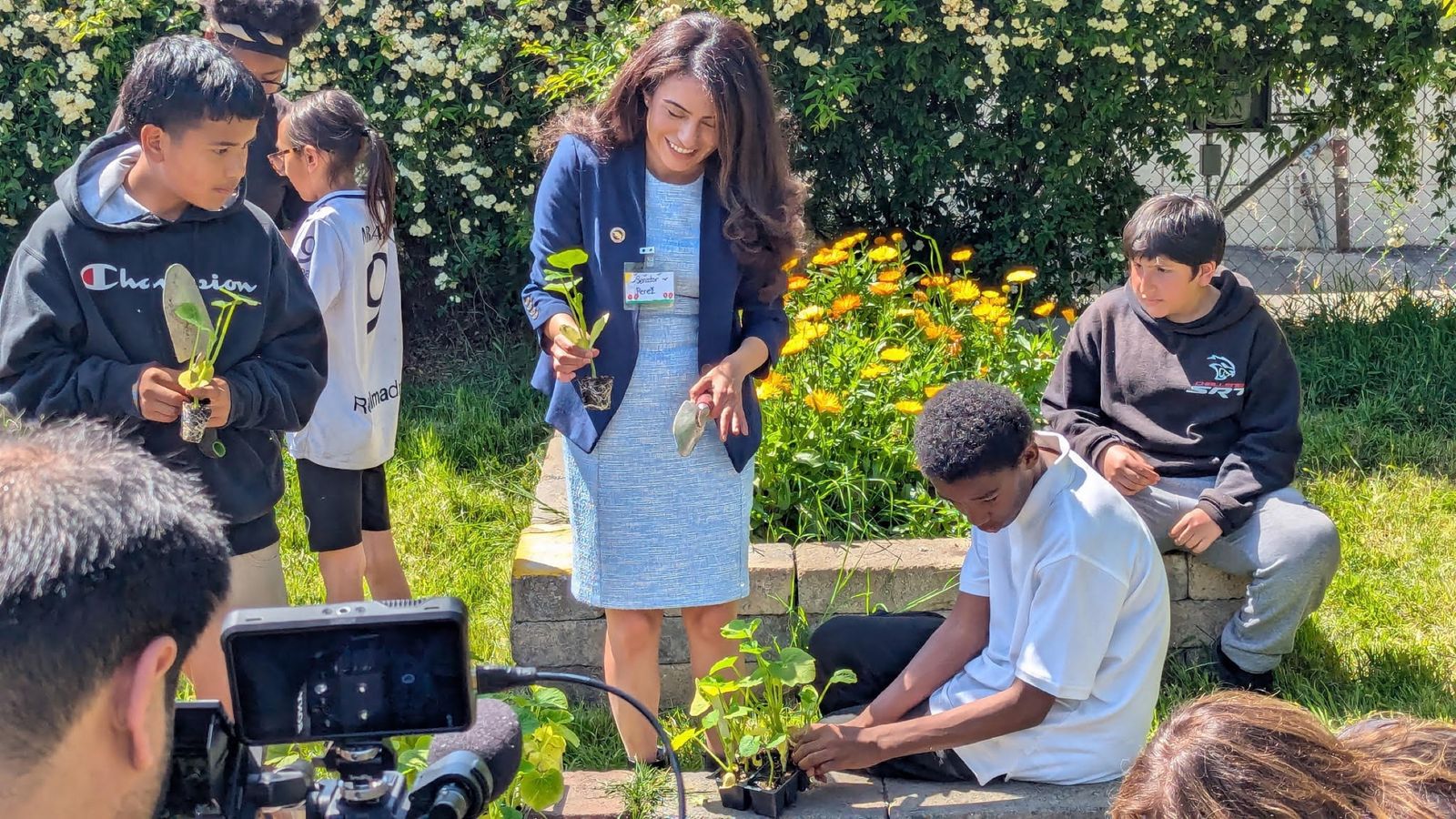
We're pleased to announce that California has committed $500 million to increasing fresh food access in schools through the Kitchen Infrastructure and Training (KIT) Fund, and for the first time in state history, hands-on food education in school gardens is an allowable use of these funds. This is the result of a two-year advocacy campaign in which our leadership team, coalition members, and Senator Sasha Renée Pérez worked together to secure state funding for school garden education.
The Success
The Kitchen Infrastructure and Training (KIT) Fund is $500 million, spread across five program areas:
- Kitchen infrastructure
- Staffing and training
- Procurement of California-grown food
- School food pantries
- Hands-on food education, including activities in school gardens, on farms, and in culinary classes
The fourth and fifth program areas are new. This is big news for school garden education programs!
What this means
School districts now have a named source of funding that they can use toward school garden education via their Nutrition Services departments, which is a great opportunity for community-based partners to collaborate with them by providing educational program components.
The funds are expected to behave as follows:
- The $500 million in funding will flow from the California Department of Education (CDE) to local education agencies (LEAs, which are school districts, county offices of education, and charter schools) in 2027. We expect disbursements in the first half of 2027, although the exact timeline is to be determined by CDE.
- Rather than a competitive grant, the funds will reach LEAs that opt in by direct allocation based on a formula set by CDE, with priority for LEAs that missed the 2025 KIT round; then LEAs serving high populations of students eligible for free or reduced-price meals, followed by total school lunches served (see Education Code section 49507 for more details). As a reference point, the 2022 KIT allocations gave every eligible LEA roughly $100,000 as a base, with the balance distributed by meal volume.
- Funds can be used toward any combination of the five program areas (e.g., an LEA could spend all funds on program area five, spread funds across all five program areas, or a couple of program areas from the list).
- LEAs have until June 30, 2030 to spend the money.
How we got here
We spent most of this year's budget cycle pursuing a one-time $25 million allocation for school garden education through the California Department of Food and Agriculture (CDFA) Farm to School Program. After the Governor’s May Revision, we pivoted to align with the influx of Proposition 98 education funding. School garden activities were ultimately codified under the KIT Fund with a much larger one-time General Fund allocation.
Our thanks go to Senator Sasha Renée Pérez and to her legislative director, Fernando Ramirez. Program area five exists because of their dedicated leadership, with our coalition supporting their efforts throughout.
What's next
- Trainings and toolkits built for both LEAs and Community-based Organizations (CBOs). School garden and nutrition education programs have a strong reputation as a strategy for inspiring students to eat more fresh foods. Nutrition Services departments may need help in planning with CBOs or other district and school leaders who are ready to provide these programs. CBOs may need support in engaging with district and Nutrition Services departments, and in growing their capacity to partner effectively as a contracted service provider. We are drafting materials for both audiences and will showcase them via webinars, outreach, and conferences, and we may also support implementation through one-on-one technical assistance. We need your help.
- Please join us on October 21 from 3:00 to 4:00 PM to shape the forthcoming draft KIT Funds: Hands-On Food Education Toolkit for CBOs (the toolkit for LEAs will follow). We will share updates, answer questions you may have, discuss strategy and next steps, and walk through the draft, which will include case studies of Nutrition Services departments partnering with CBOs, outreach templates for connecting with principals and Nutrition Services departments, and a clear overview of KIT funding timelines so a CBO can approach an LEA ready to be the implementing partner. Your input will make it a resource for CBOs across the state. Register here.
- Partnering with CDE. CDE invited us to host future training webinars to showcase how LEAs can use these funds for hands-on food education and garden activities, including partnering with CBOs. We intend to showcase the LEA-facing toolkit for these training sessions.
- To do the above work, we are raising $80,000 for project management. We are grateful to Garden School Foundation for $2,500 and Living Classroom for $5,000, and to Growing Together, whose foundational support carried the successful advocacy campaign this past year.
Beyond this year:
- The program is now permanent in the Education Code, but the funding is not yet annual. Ideally, the funds would be ongoing, with a set-aside dedicated specifically to hands-on food education.
- Our goal for the three-year implementation period will be to ensure that partnerships between state agencies, school districts, and CBOs result in the best possible student outcomes, and that these successes are measured and presented to key stakeholders. Our coalition has no dedicated funding source at this point to do this. This is where your help matters most.
Other updates
- CDFA's Farm to School Program is now permanent, with $24.6 million in ongoing annual funding secured in the 2026-27 budget, replacing the one-time allocations the program has largely run on since 2020. For this grant cycle, the Budget Acts of 2025 and 2026 together provide $40 million, with up to $38 million in awards. Applications open October 1 and are due December 31.
- CTA: The program is restructuring from four tracks to three, and Track 2 is now a subaward track organized into subcategories, including education, that CBOs apply to. On the LEA side, Track 1 draft guidelines currently require a minimum of 20% of funds to be spent on hands-on education with students, and instructional time will likely be a key grant deliverable. Please provide public comment by September 11 to support these program changes.
- Federal funding. USDA and HHS announced the Harvest to Hallways initiative: $125 million nationally, including $50 million for school cafeteria infrastructure and $25 million in additional Patrick Leahy Farm to School grants. This will help some California districts.
- A new state fund school gardens could qualify for. SB 54 requires plastic packaging producers to pay $500 million a year for ten years, beginning July 2027, into the Plastic Pollution Mitigation Fund. Funds must go toward reducing the environmental justice and public health impacts of plastics on communities, wildlife, and ecosystems. Education is not named, so the path for school gardens runs entirely through the grant guidelines being written now. Funds cannot be awarded until the Legislature appropriates them, so 2027 is the earliest grants could open.
- CTA: School gardens fit the fund's purpose as they reduce students' reliance on packaged, plastic-wrapped food and build community health. Please provide public comment by September 30 asking that hands-on food education in school gardens be explicitly named as an eligible use.
- Meta settlement. Meta agreed in August to pay up to $17 billion over ten years to settle youth mental health claims nationwide, and "outdoor activities" is named among the intended uses alongside after-school programming and youth mental health services. About $2 billion is expected to flow to California for the legislature to appropriate in the 2027-28 budget.
- Campaign for Outdoor Learning. AB 2158 was held in suspense in Senate Appropriations and will not move forward. The coalition is considering next steps. The bill would have recognized outdoor learning in the Education Code as an effective instructional method and provided statewide outdoor learning guidance.
- Share the compost poster contest with your schools. The ICAW poster contest is open through October 22, with a $500 prize and designs shared internationally.
How you can help
- Ask one of your funders to participate. Share your involvement in the coalition and this exciting news with a funder you already have a relationship with to assess whether they might be interested in making a contribution to support our statewide awareness-raising and implementation so as many kids as possible can benefit from our advocacy. Whether you forward this email, connect us directly, or would like to strategize on the approach with Vicki Moore, we would be deeply grateful. Our goal is to secure $72,500, which would give us a budget of $80,000 and allow us to play a critical role in this new statewide initiative throughout an initial implementation year for the short-term work.
- Invite your network to join the coalition. Forward this email and invite them to sign up to receive notifications.
Questions, ideas? Just reply to this email. We will take all replies and share FAQs with everyone in the near future as we gain more information.
Thank You
This win took years, and it took all of us:
- Our legislative champion Senator Sasha Renée Pérez, Senator John Laird, and many supportive elected officials, as well as the committee members and consultants who supported this effort.
- Everyone who signed our letter of support this year.
- Everyone who signed our letter of support last year for SB 341 (Pérez, 2025), which helped us build the relationships necessary for this year’s budget allocation.
- Everyone who showed up in Sacramento for Advocacy Day both years to meet with 50+ legislators.
- Our leadership team for spending a few hours/week strategizing and executing.
- Our funders, big and small!
- Those who happily made introductions to key players in Sacramento and gave us advice.
- The dedication and vision of the hundreds of grassroots leaders, teachers, and parents who have spent years, even generations, building these cherished programs in school communities around the state.
Now the work shifts from getting the money to making sure it impacts students. We will keep you posted, and we will update our website in the coming weeks.
With gratitude,
Linda Livers Prosser
On behalf of the California School Garden Coalition Leadership Team